Dental Implants | St. George, Utah
Diagnosis, bone grafting, placement, and the final tooth. One doctor. One office. No referrals across town.
I was the first full-service dental implant dentist in Southern Utah, and I have been placing them for decades since. That is not a line I use lightly. It means that when most dentists were still sending implant patients elsewhere, I was already doing the whole thing myself.
I still do. From the first 3D scan to the final crown, your entire implant journey happens here, with me. You are never handed off to a surgeon in one office and a restoring dentist in another, hoping the two coordinate.
What dental implants are
A dental implant is a small titanium post that I place into your jawbone, where it acts as the root of a new tooth. On top of it goes a crown, a bridge, or a denture, depending on what you need.
That is what sets an implant apart from the older ways of replacing teeth. A traditional bridge leans on the teeth beside the gap. A removable denture sits on the gums and can slip. An implant stands on its own, anchored in bone, the way a natural tooth does.
The result is the strongest, most natural-feeling replacement available. It does not decay, it does not rely on the teeth around it, and cared for properly, it is built to last.
The story behind the experience
I have been a member of the AAID (American Academy of Implant Dentistry) since 1993. That is one of the longest-standing implant credentials anywhere in this region, and there is a real story behind how I got here.
Straight out of dental school, I trained under Dr. Dean Doyle.
To understand why that matters, you have to understand who he was. This was the very beginning of implant dentistry in America. Dr. Doyle was one of a small handful of visionaries, alongside names like Misch and Linkow, who were figuring the field out from scratch, consulting with each other to work out best practices that simply did not exist yet. He was so far ahead of his time that other dentists in his area actually tried to have his license taken away, insisting implants would ruin people's jaws. He used to joke that he would pull out the X-rays of his successful cases now and then, just to remind himself that implants worked, since everyone around him kept saying they did not.
He was right, and they were wrong. History settled that.
I graduated in the top five of my class and was the number one student my senior year, which is how the oral surgeons took me under their wing and eventually recommended me to Dr. Doyle. I trained with him for a year and a half across his two offices, assisting on his implant cases, administering the IV sedation for them, and completing advanced training including the subperiosteal implant course. He launched me at least ten years ahead of my peers.
Then I brought all of it home to St. George. Decades of hands-on refinement later, I am still placing implants, and I have seen this field grow from a single implant company to well over sixty. I know what works and what does not, because I was here for all of it.
Why full-service, in-house matters
Here is something most patients do not realize until they are in the middle of it.
When many general dentists say they "do implants," what they mean is that they send you to an oral surgeon or periodontist for the placement, then bring you back months later for the crown. Two offices. Two providers. Two schedules to coordinate, and a seam in the middle where things can go wrong.
I do all of it myself. Diagnosis, any bone grafting you need, the placement of the implant, and the final crown, bridge, or denture on top. Same doctor, same office, start to finish.
That continuity is not a convenience feature. It changes the quality of the result. When I am the one placing the implant, I place it at the exact angle and position that will give the best final tooth, because I am the one who will be building that tooth. When a separate office places the implant without coordinating directly with the person restoring it, that is where problems get built in from the start.
For you it also means fewer appointments, no ferrying records between offices, and a single person accountable for the entire outcome. And if you would like, the placement itself can be done under IV sedation, so the whole thing is comfortable.
The in-house process, step by step
Consultation & 3D Imaging
We meet, we talk, and I take a 3D cone-beam scan. This matters more than it sounds. A traditional flat X-ray shows me a shadow. A cone-beam scan shows me your bone in three dimensions, so I can plan the placement precisely instead of estimating. For implants, that precision is everything.
Bone Grafting, If You Need It
If there is not enough bone to anchor the implant well, I graft it, right here, as part of your care. This is exactly why patients who have been told they "don't have enough bone" elsewhere are often still candidates with me.
Placement
I place the implant at the angle and depth planned from your scan, positioned for the best final result. This can be done under IV sedation if you prefer.
Healing
The implant needs time to fuse with your bone. This is the body doing its work, and it is worth the wait.
The Final Restoration
Once healed, I build and fit your crown, bridge, or denture, made to match and made to last.
Because every stage happens in one place, nothing gets lost between offices.
Types of implant treatment
Single-Tooth Implants
One missing tooth, replaced with one implant and one crown, without touching the healthy teeth on either side.
Multiple-Tooth & Bridge-Supported Implants
Several missing teeth restored with implants that support a bridge, no removable appliance needed.
Full-Arch Solutions
A full set of teeth supported by implants, for patients who have lost or are losing all their teeth in an arch.
Rebuilding a whole mouth? See full mouth reconstructionImplant-Supported Dentures
A far more stable, permanent-feeling alternative to a traditional removable denture, anchored by implants so it does not slip. This opens up the ability to easily clean the parts above the gums that attach to the denture, and to clean the denture itself, which is very important.
I also place subperiosteal implants, a specialized solution I trained in directly, which remains the right answer for certain patients with significant bone loss.
Results patients can see
Over my career I have placed hundreds and hundreds of implants, and I continue to place a great many each year.
The results speak for themselves. My overall implant success rate is around 98% to 99%. That is not a number I take for granted. It comes from decades of refining every step, and from being willing to change course the moment something is not performing. Years ago I even walked away from an entire implant brand that was not living up to the standard my patients deserve, because I would rather switch to a proven system than accept anything less. Choosing the right materials, and being honest about them, is part of how that success rate stays where it is.
I also place most implants under sedation, though that is always your choice. I highly recommend it. Some patients are solid as a rock in the chair and do not need it, but for precise work like implant placement, a calm, comfortable patient is better for everyone, and the vast majority of mine choose to have it done that way.
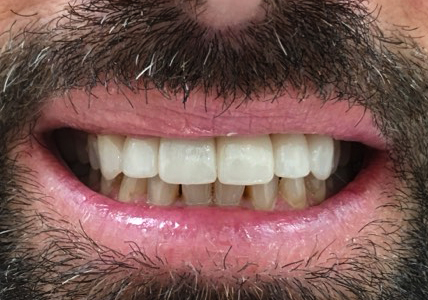
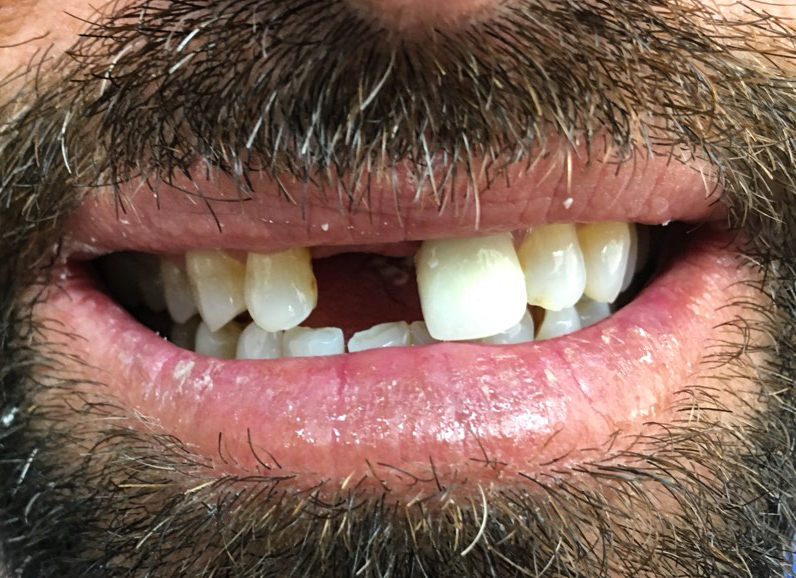
Before Implant Restored and Front 6 Teeth
Is an implant right for you?
You may be a good candidate if you are missing one tooth, several teeth, or a full arch, or if you are tired of a denture that slips and feels uncomfortable. Most people who want a long-term, natural-feeling replacement are candidates.
And if you have been told elsewhere that you do not have enough bone, do not count yourself out. Because I handle nearly all bone grafting in-house, many patients who were turned away somewhere else are still very much candidates here.
The only way to know for sure is to look at your actual situation, which is what the free consultation is for.
With proper care, implants are designed to last a very long time, often a lifetime. They are the most durable tooth replacement available.
Most patients are surprised by how manageable it is. And because I offer IV sedation, you can have the placement done while completely comfortable, with little to no memory of it.
It varies. The main variable is the healing period, during which the implant fuses to your bone. We map out your specific timeline at the consultation so you know what to expect.
Yes, and most of my patients choose it. Precise work like this is best done with a calm, comfortable patient, and IV sedation makes that easy.
Age is rarely the deciding factor. What matters is your health and your bone, both of which we assess directly. I have treated patients across a wide age range.
If you are missing teeth, or living with a denture you have never liked, come find out what implants could do for you.
The consultation is free, there is no obligation, and you will leave with a real answer about your own situation, from the doctor who brought full-service implants to Southern Utah.
Serving St. George, Santa Clara, Washington, Ivins, Hurricane, and all of Southern Utah.